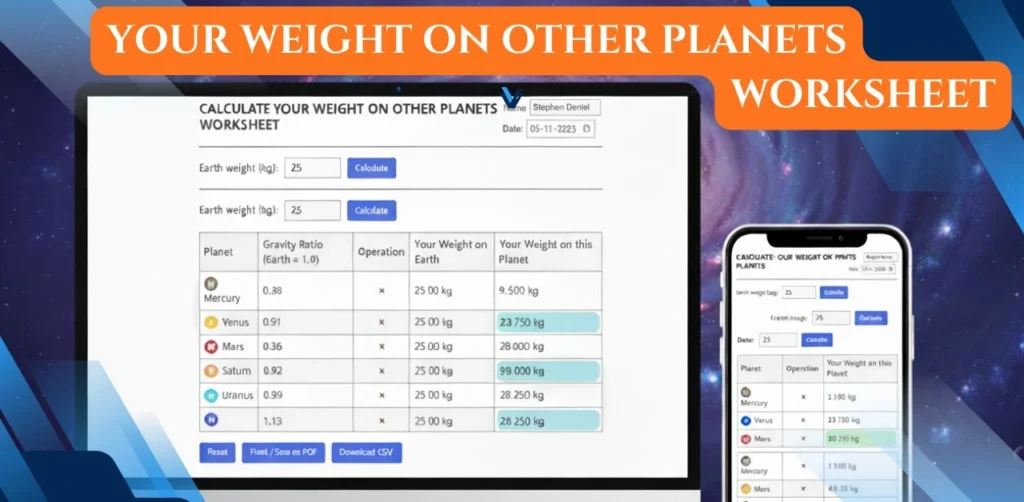
CALCULATE YOUR WEIGHT ON OTHER PLANETS
| Planet | Gravity Ratio (Earth = 1.0) | Operation | Your Weight on Earth | Your Weight on this Planet |
|---|---|---|---|---|
| Mercury | 0.38 | × | ||
| Venus | 0.91 | × | ||
| Earth | 1.00 | × | ||
| Mars | 0.38 | × | ||
| Jupiter | 2.36 | × | ||
| Saturn | 0.92 | × | ||
| Uranus | 0.89 | × | ||
| Neptune | 1.13 | × |
Calculate Your Weight on Other Planets Worksheet
Have you ever imagined what it would feel like to step on Mars, Jupiter, or Saturn — and how much you’d weigh there? The Your Weight on Other Planets Worksheet helps you calculate your body weight across different planets using each planet’s gravitational force compared to Earth.
This interactive tool makes space science fun and practical — perfect for students, teachers, and astronomy lovers who want to explore the wonders of planetary gravity.
🪐 What is “Your Weight on Other Planets Worksheet”?
The Your Weight on Other Planets Worksheet is a free online calculator that instantly converts your Earth weight into its equivalent on other planets.
Since gravity differs from planet to planet, your weight also changes. For example:
- You weigh less on Mars because it has weaker gravity.
- You weigh more on Jupiter because its gravity is much stronger.
This worksheet helps visualize those differences through an interactive table or printable worksheet.
How to Use the Weight on Other Planets Worksheet
Using this calculator is simple and engaging. Follow these steps:
- Enter your weight on Earth (in kilograms).
- Click “Calculate.”
- Instantly see your weight displayed across all major planets — Mercury, Venus, Earth, Mars, Jupiter, Saturn, Uranus, and Neptune.
- Download or print your worksheet for educational use.
- Share or save your results to compare with friends or classmates.
You can also explore similar tools for astronomy learning:
👉 Age on Mars Calculator
👉 Space Age Calculator
👉 Space Travel Time Calculator
👉 Factorio Space Age Calculator
👉 Pluto Time Calculator
Formula to Calculate Your Weight on Other Planets
The Your Weight on Other Planets Worksheet uses this simple formula:
\(\text{Weight on Planet} = \text{Weight on Earth} \times \text{Planet’s Gravity Ratio}\)Where:
- Weight on Earth = your body weight in kilograms (kg)
- Planet’s Gravity Ratio = gravitational force compared to Earth (Earth = 1)
Example:
If your Earth weight is 60 kg and you want to know your weight on Mars:
\(\text{Weight on Mars} = 60 \times 0.38 = 22.8 , \text{kg}\)So, on Mars, you’d weigh 22.8 kg instead of 60 kg on Earth!
Gravity Ratios of Planets
| Planet | Gravity Ratio (Earth = 1.0) | Example Weight (for 70 kg person) |
|---|---|---|
| Mercury | 0.38 | 26.6 kg |
| Venus | 0.91 | 63.7 kg |
| Earth | 1.00 | 70.0 kg |
| Mars | 0.38 | 26.6 kg |
| Jupiter | 2.36 | 165.2 kg |
| Saturn | 0.92 | 64.4 kg |
| Uranus | 0.89 | 62.3 kg |
| Neptune | 1.13 | 79.1 kg |
From this table, you can see that your heaviest weight would be on Jupiter, and the lightest weight would be on Mercury or Mars.
Gravity and Weight on Other Planets
Here’s how your weight would change across the solar system if you weigh 60 kg on Earth:
| Planet | Gravity Ratio | Weight (in kg) | Comparison to Earth |
|---|---|---|---|
| Mercury | 0.38 | 22.8 | Much lighter |
| Venus | 0.91 | 54.6 | Slightly lighter |
| Earth | 1.00 | 60.0 | Normal |
| Mars | 0.38 | 22.8 | Much lighter |
| Jupiter | 2.36 | 141.6 | Much heavier |
| Saturn | 0.92 | 55.2 | Slightly lighter |
| Uranus | 0.89 | 53.4 | Slightly lighter |
| Neptune | 1.13 | 67.8 | Slightly heavier |
🧠 Fun Fact: You’d weigh over twice as much on Jupiter and less than half on Mars!
🪐 Why Does Weight Change on Other Planets?
Weight depends on gravity, and gravity depends on:
- Mass of the Planet – Larger planets pull harder.
- Distance from the Planet’s Center – The closer you are to the core, the stronger the pull.
Even though your mass stays the same everywhere, your weight changes due to different gravitational strengths.
🧾 Educational Use of the Worksheet
This Your Weight on Other Planets Worksheet is an excellent classroom resource. Teachers can:
- Use it for STEM projects or space science lessons
- Help students visualize gravitational differences
- Print and distribute the worksheet for offline use
It’s an exciting way to learn how science explains what we’d feel on other planets.
Example Activity
- Take your class’s average Earth weight.
- Use the calculator to fill in weights for all planets.
- Create a bar graph comparing planetary weights.
- Discuss which planets have the strongest and weakest gravity.
This makes it a perfect hands-on learning experience!
Related Tools and Calculators
To explore more space and time-based concepts, check out:
- 🪐 Age on Mars Calculator
- 🌌 Space Age Calculator
- 🚀 Space Travel Time Calculator
- ⚙️ Factorio Space Age Calculator
- 🪓 Pluto Time Calculator
- 🎂 Birth Year Calculator
- 🔢 Age Difference Calculator
- ⏳ Chronological Age Calculator
- 📅 Days Calculator
Each of these tools is part of the growing collection on DateOfBirthCalculator.co.in — a trusted platform for age, date, and space-related calculators.
FAQs
Q1. Why do I weigh differently on other planets?
Because gravity varies. A stronger gravitational pull (like on Jupiter) increases your weight, while a weaker one (like on Mars) makes you lighter.
Q2. Can I use this worksheet for classroom projects?
Yes! It’s designed for both online use and printable worksheet format, ideal for educational purposes.
Q3. Does my mass also change on other planets?
No, your mass remains constant everywhere. Only weight changes with gravity.
Q4. Is this calculator scientifically accurate?
Yes. It’s based on verified gravitational ratios used in space science education.
Conclusion
The Your Weight on Other Planets Worksheet is a fascinating way to understand gravity’s effect on weight. Whether you’re a student, a teacher, or a curious space enthusiast, this tool transforms scientific theory into interactive exploration.
Try it today on DateOfBirthCalculator.co.in — and discover how your weight changes from Mercury to Neptune!
Source & Reference Pages