Age on Other Planets Calculator
Find out how old you’d be on Mercury, Venus, Mars, Jupiter, and more.
Related
🪐 Space Age Calculator – Age on Other Planets
What Is the Space Age Calculator?
The Space Age Calculator is a fun and educational online tool that helps you discover how old you would be on other planets in our solar system.
Because each planet takes a different amount of time to orbit the Sun, your age in planetary years would change depending on where you are in space.
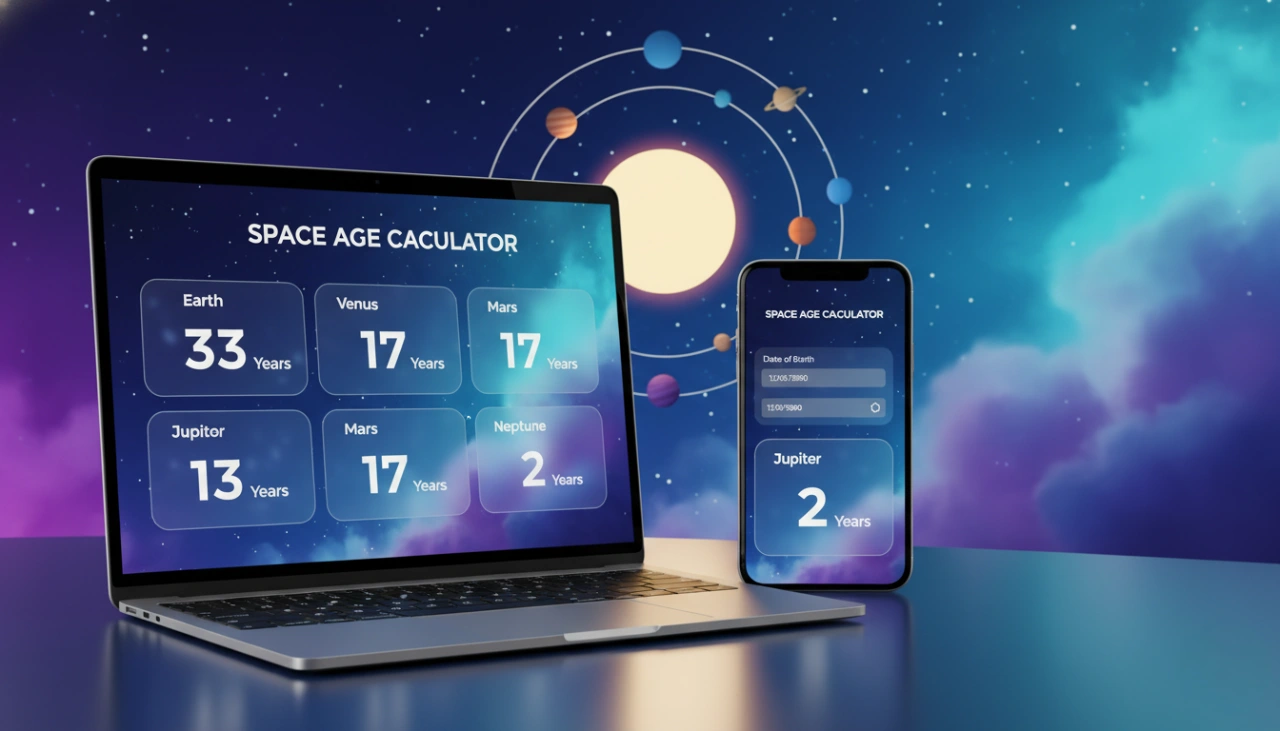
For example, a person who is 30 years old on Earth would be nearly eight times older on Mercury but only a fraction of that age on Neptune.
The Space Age Calculator instantly converts your Earth age into equivalent ages on Mercury, Venus, Mars, Jupiter, Saturn, Uranus, and Neptune, showing all results beautifully in one place.
How Does the Space Age Calculator Work?
Every planet has a unique orbital period — the time it takes to complete one revolution around the Sun.
The calculator uses these orbital ratios to find your age across different worlds.
Here’s the general formula used:
\(\text{Planet Age} = \text{Earth Age} \times \frac{\text{Length of Earth Year (365.26 days)}}{\text{Length of Planet’s Year (in days)}}\)This means that if a planet’s year is shorter than Earth’s, your Space Age on that planet will be greater.
If it’s longer (like Neptune or Uranus), your planetary age will be smaller.
🪐 Planetary Orbital Periods and Conversion Formulas
Each planet takes a different time to orbit the Sun, which means a year on every planet is unique. The Space Age Calculator uses these orbital ratios to calculate your equivalent age on other planets. Below are the conversion formulas for each world.
🌍Earth
1 Earth year = 365.26 Earth days (used as the base reference).
\(\text{Earth Age} = \text{Your Age in Years}\)☿ Mercury
1 Mercury year = 88 Earth days
\(\text{Mercury Age} = \frac{\text{Earth Age} \times 365.26}{88}\)♀ Venus
1 Venus year = 224.7 Earth days
\(\text{Venus Age} = \frac{\text{Earth Age} \times 365.26}{224.7}\)♂ Mars
1 Mars year = 686.98 Earth days
\(\text{Mars Age} = \frac{\text{Earth Age} \times 365.26}{686.98}\)♃ Jupiter
1 Jupiter year = 4,332.59 Earth days
\(\text{Jupiter Age} = \frac{\text{Earth Age} \times 365.26}{4332.59}\)♄ Saturn
1 Saturn year = 10,759.22 Earth days
\(\text{Saturn Age} = \frac{\text{Earth Age} \times 365.26}{10759.22}\)♅ Uranus
1 Uranus year = 30,688.5 Earth days
\(\text{Uranus Age} = \frac{\text{Earth Age} \times 365.26}{30688.5}\)♆ Neptune
1 Neptune year = 60,182 Earth days
\(\text{Neptune Age} = \frac{\text{Earth Age} \times 365.26}{60182}\)♇ Pluto (Dwarf Planet)
1 Pluto year = 90,560 Earth days
\(\text{Pluto Age} = \frac{\text{Earth Age} \times 365.26}{90560}\)How to Use the Space Age Calculator
- Enter your age in Earth years (for example, 25 or 30).
- Click the “Calculate” button.
- Instantly view your age on every planet displayed in elegant glass-style cards.
- Each card includes a Copy button, so you can share your cosmic ages easily.
The Space Age Calculator is perfect for astronomy enthusiasts, students, or anyone who loves exploring how time works across the universe.
Example Calculation
Let’s say you are 30 years old on Earth.
Using Mars as an example:
\(\text{Mars Age} = 30 \times \frac{365.26}{686.98} = 15.95 \text{ Mars years}\)So, on Mars, you would have celebrated only about 16 birthdays — almost half your Earth age!
But on Mercury, where a year lasts only 88 Earth days, you’d be about 124 years old!
Fun Space Facts
- A year on Venus is shorter than its day — meaning a Venusian day lasts longer than a Venusian year!
- If you lived on Neptune, you might never have a birthday — it takes 165 Earth years to orbit the Sun.
- Jupiter spins so fast that a day there lasts less than 10 Earth hours.
These unique time cycles make the Space Age Calculator not only fun but also a great educational tool for understanding planetary motion.
Why Your Age Changes Across Planets
Your Space Age depends on how long it takes a planet to orbit the Sun.
Since planets closer to the Sun move faster, you’d age more quickly there.
Outer planets move slower, so you’d experience fewer birthdays over the same period.
For example:
- Fast orbit → More birthdays (Mercury, Venus)
- Slow orbit → Fewer birthdays (Uranus, Neptune)
FAQs – Space Age Calculator
How is 1 hour in space equal to 7 years on Earth?
That idea comes from Interstellar, a sci-fi movie. It’s based on time dilation near a black hole – where gravity bends time. In reality, astronauts in orbit experience only milliseconds of difference compared to Earth.
How long is 5 years in space on Earth?
For real astronauts in low Earth orbit, 5 years in space ≈ 5 years on Earth, with only a few minutes’ time difference due to relativity.
In which planet is 1 hour equal to 7 years?
No planet causes such extreme time dilation. That only happens near massive black holes like Gargantua (fictional). All planets in our solar system experience time nearly the same as Earth.
How old am I on Mars?
Mars takes 686.98 Earth days to orbit the Sun, so
If you’re 25 on Earth, you’d be about 13.3 years old on Mars.
Who stayed 1000 days in space?
Oleg Kononenko, a Russian cosmonaut, became the first person to spend 1,000 days in space (as confirmed by Roscosmos). His remarkable achievement marks a new milestone in human space exploration.
Related
Final Thoughts
The Space Age Calculator turns astronomy into an interactive experience.
It shows how relative time works on different worlds, helping you see your life from a cosmic perspective.
No matter your age, this calculator offers a glimpse into how time expands and contracts across the solar system — a fascinating reminder of how vast and varied our universe truly is.